OSETRA RUSSIAN STURGEON
Shelf life: up to 6 months unopened and 1-2 days after opening, refrigerated.
Storage: keep between -2 C and +4 C in the coldest part of the refrigerator. Storage in the transport box with cooling packs is possible only while the packs remain frozen.
Temperature-controlled delivery: every product travels in a specially designed insulated thermal box with professional gel cooling packs, maintaining -2 C to +4 C for up to 48 hours.
Freshness guaranteed to your door.
Opening: carefully slide a flat spoon or dedicated caviar opener under the edge of the lid. Avoid sharp knives. Open immediately before serving.
Serving: serve well chilled over crushed ice. Use only a mother-of-pearl, horn, bone or glass spoon. Metal utensils can disturb the delicate fats and alter the flavor profile.
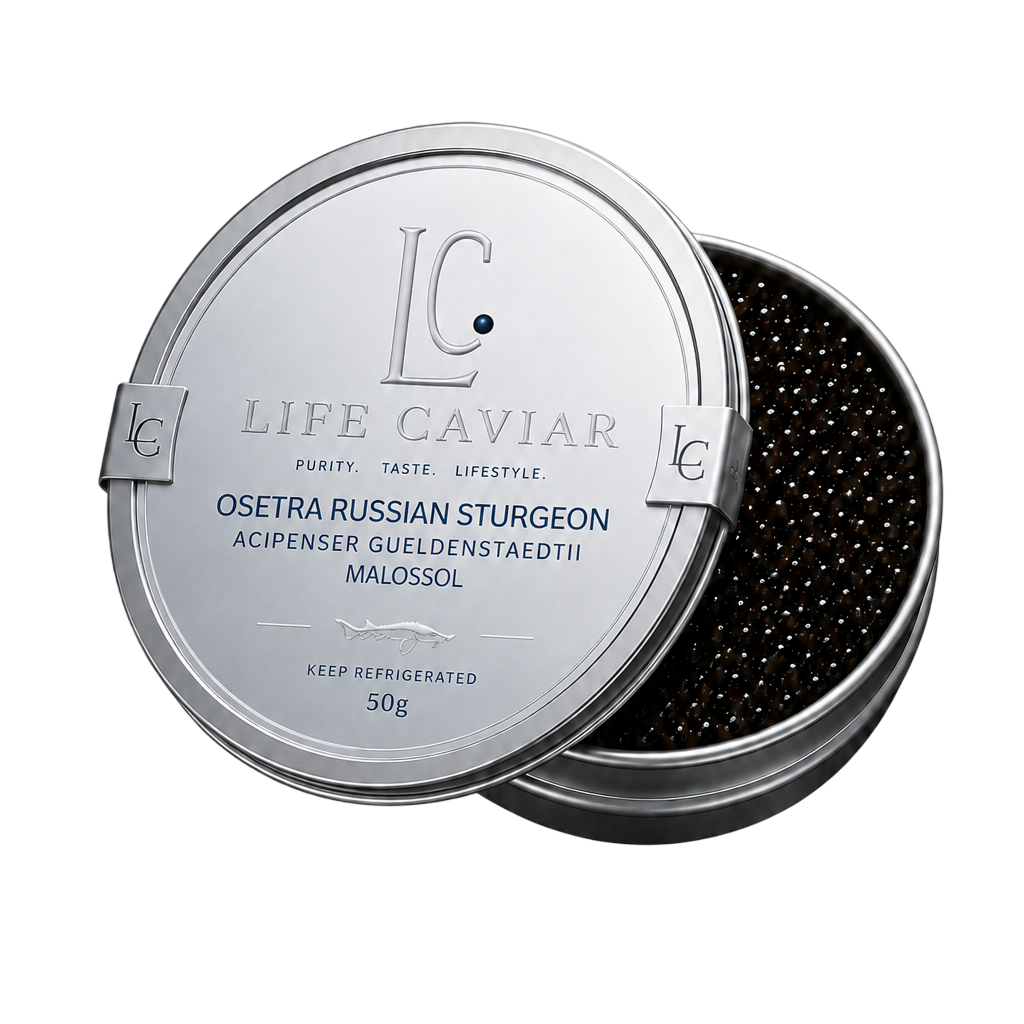
The caviar images on our website are intended for illustrative purposes only. As caviar is a natural product, variations in color and pearl size are possible. If you have any uncertainty or need information about your caviar tin, please contact us. We are always available to answer. contact
About the product
Recommended serving quantity
| Occasion | Quantity per person |
|---|---|
| Tasting / aperitif | 10 g - 15 g |
| Starter | 20 - 30 g |
| Main experience | 50 g |
| Gift / special occasion | 100 g |
Perfect accompaniment
Pairs with:
- Drinks: Extremely high grade champagne (Blanc de Blancs or prestigious
Prestige Cuvée), which perfectly balances the fat content, or ultra-premium pure vodka. - Food: Warm, fluffy blini, high quality crème fraiche or fine, delicately
baked brioche slices. - What to avoid: Absolutely any aggressive tastes, lemon, onions, or capers. The complex and rich taste of Osetra requires minimalist company to shine through.
Acipenser gueldenstaedtii · Russian sturgeon
The word Ossetra is a transcription of Russian osetra - which literally means “sturgeon caviar”. The spelling itself varies — Ossetra, Osetra, Oscietra, Osietra — depending on the country and the market, but behind all the names is the same species.
Ancient type, royal table
Acipenser gueldenstaedtii is an ancient fish born in the Caspian Sea, the Black Sea and their river systems, valued for centuries for the rich, nutty and elegant taste of its caviar.
During the time of the Russian Empire, Ossetra caviar gained exceptional popularity — it was served at the table of the tsars and the aristocracy. (ResearchGate) In the 19th century, Russia began exporting caviar to Europe, with Ossetra being among themostsought-after varieties, quickly gaining recognition for its superior quality.
The Peak and Fall of Wild Hunting
At the peak of commercial fishing in the Caspian Sea — 1977 — A. gueldenstaedtii is themost harvested species, accounting for 79% of the total sturgeon catch, or over 21,000 tonnes. ) Decades of overfishing, pollution and habitat destruction have devastated populations. At the end of the 20th century, wild populations were seriously threatened and the species was declared critically endangered.
Caviar today
The continuous decline in natural populations and high market demand have boosted aquaculture cultivation of sturgeons — today Russia, Iran, EU countries, China and the United States are among the leading producers.
Ossetra is the second mostsought-after caviar in the world after Beluga. Its color varies from dark brown to golden —lighter beans are rarer, have a richer taste and come from older fish.
Product information
| Name | Russian sturgeon caviar (Acipenser gueldenstaedtii) |
|---|---|
| Composition | Russian sturgeon caviar, salt (up to 3%). |
| Description | From dark olive and deep bronze to warm amber and golden tones. Velvety texture with juicy pearls. Complex and deep taste with a dominant buttery character and notes of roasted hazelnuts. |
| Energy | 1105 kJ / 264 kcal |
|---|---|
| Fat | 17.9 g |
| of which saturates | 4.1 g |
| Carbohydrates | 4.0 g |
| of which sugars | 0.01 g |
| Protein | 24.6 g |
| Salt | up to 3.0 g |